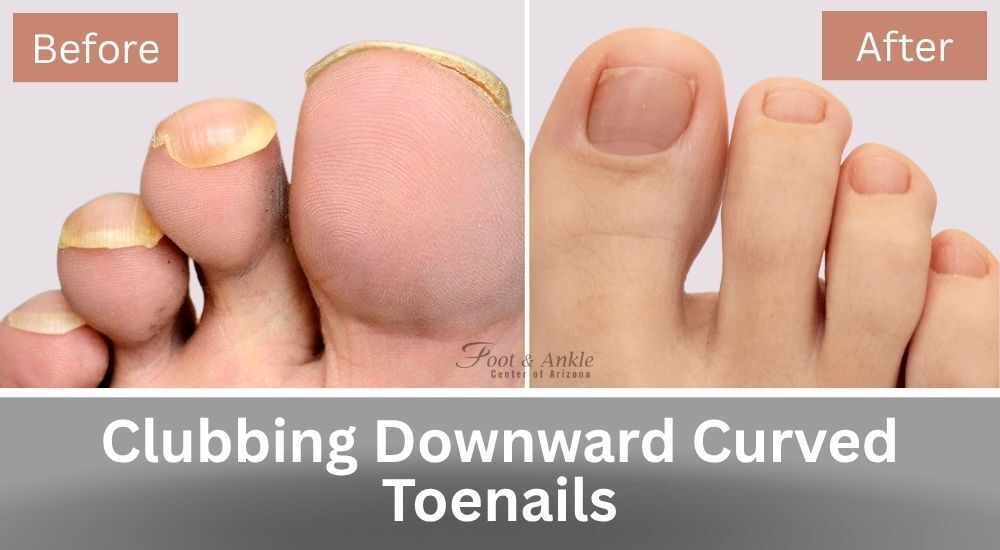
Healthy toenails often go unnoticed—until something changes. One of the more concerning changes that people experience is the clubbing or downward curving of toenails. While it may seem like a simple cosmetic issue, this condition can sometimes be a sign of underlying health concerns or biomechanical imbalances in the feet.
In this article, we’ll explore what causes clubbed and downward-curving toenails, when you should be concerned, and why professional evaluation is essential for proper diagnosis and treatment.
Clubbing of the toenails refers to the enlargement of the nail bed combined with a noticeable curve downward at the nail tips. Instead of lying flat, the nail grows in a hooked or arched shape that can look as though it’s wrapping around the toe. This condition is also known as nail hypertrophy and may include swelling of the toe or changes in the texture of the nail.
This appearance is often confused with simply “curved toenails,” but true clubbing is more rounded and bulbous in shape and may affect both fingers and toes.
A mild curve in the nail could be harmless and simply the result of tight shoes, trauma, or genetics. But true nail clubbing is often associated with more serious systemic issues, such as:
That’s why it’s critical not to self-diagnose. Even if the issue seems minor or only cosmetic, early detection by a foot and ankle specialist can rule out—or identify—underlying health issues that may require further evaluation.
While clubbing is often systemic, non-systemic downward curving of toenails may be caused by:
If you notice any of the following symptoms alongside the curved or clubbed appearance of your toenails, it’s important to consult a specialist:
A proper diagnosis begins with determining whether your curved toenails are clubbing-related or due to localized issues. At the Foot and Ankle Center of Arizona, our expert team—led by board-certified podiatrist Dr. Kris A. DiNucci—uses advanced diagnostic tools and clinical evaluation to identify the root cause of the nail deformity.
In many cases, we also assess your walking pattern, footwear history, and any possible underlying medical conditions that could contribute to the nail changes.
The treatment plan depends on the underlying cause. Here are a few common approaches our clinic may recommend:
If your curved nails result from foot pressure or gait problems, custom orthotics or shoe recommendations can alleviate the strain on the toes and prevent further nail distortion.
If onychomycosis is detected, antifungal treatments—either topical or oral—may be used to restore healthy nail growth.
For severely curved or painful nails, medical trimming, nail thinning, or partial nail removal (matrixectomy) may be necessary to relieve discomfort and encourage normal nail regrowth.
If nail clubbing is linked to heart, lung, or gastrointestinal issues, our team will coordinate with your primary care physician or appropriate specialist for further evaluation.
Don’t wait for pain or severe symptoms. You should book a consultation if you notice:
Early intervention leads to better outcomes—and in some cases, could alert you to an undiagnosed medical condition.
At our Scottsdale-based clinic, we take toenail conditions seriously—because they are often more than skin-deep. With over 25 years of experience, Dr. DiNucci and his dedicated team provide:
We’ve helped hundreds of patients regain comfort, confidence, and nail health—and we’re here to help you too.
Clubbing or downward curving of toenails is more than just a cosmetic concern—it can be a signal from your body that something needs attention. Whether it’s caused by poor biomechanics, footwear, or a systemic health issue, professional evaluation is the safest and smartest way to find answers and get relief.